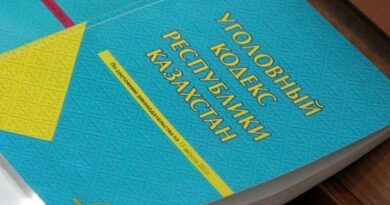

President of Kazakhstan was suggested to cancel the death penalty
Members of the National Council of Public Confidence (NCPC), the first meeting of which was held on September 6 in Nur-Sultan, asked the President to replace the death penalty by the life imprisonment punishment.
The proposal came from a member of the NCPC, a political analyst Aydos Sarym. “Having regard to the public opinion, doing various surveys, we propose to review the concept of the death penalty; so it should be replaced by the life sentence,” he said.
As ACCA was informed by the NCPC, the proposal was developed jointly by the participants of the working group on political reforms.
It should be noted that the NCPC was created by decree of the President of Kazakhstan Kasym-Zhomart Tokaev in order to establish a public dialogue between the government and society. The structure of the NCPC included 41 people; they are representatives of various fields – political scientists, economists, lawyers, public figures and bloggers. Within the framework of the National Council, several working groups have been created, such as on political reforms, on issues of language and culture, on social policy, etc.
In addition to the abolition of the death penalty, the working group on political reforms presented several proposals to the Head of state. According to Aydos Sarym, the members of the working group on political reform also consider that it’s necessary to revise the Law: “On public meetings”, “On political parties”, “On mass media”, “On elections” and “On parliamentarians”.
“The legislation needs to be liberalized and the system of deterrence and counterbalances must be balanced between the branches of government. If we consider these points, then we will have the right electoral elections, political pluralism, political competition,” the political scientist noted, explaining that, for example, the Law “On public meetings” needs to prescribe guarantees for freedom of speech. “That is, each side must understand what permissions to these meetings should have. The Law “On political parties”, for example, must take into account the citizenship of every citizen and there should not be qualifications when creating and registering political parties, these restrictions and qualifications must be reduced. In the law “On mass media”, it is necessary to specify the concept of “mass media”, as well as to legitimize the concept of fake news. In the law on deputies, it is necessary to consider the possibility of forming a parliamentary opposition, it is necessary to introduce the open work of the Parliament’s deputies.”