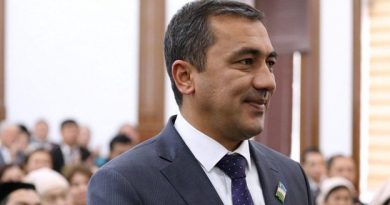

Kazakhstan: Colonel of the National Security Committee and his wife were convicted of fraud
The Court No. 2 of Esil district of Nur-Sultan city delivered a judgment concerning the case of the Deputy Head of Department 3 of the National Security Committee, Ermek Arystan, and his wife Elmira Duisenkyzy. They were accused of fraud and incitement to bribe.
This story began in November 2019. Vice-rector of the South Kazakhstan State University Kanat Baibolov found out that his son couldn’t enter the Academy of the National Security Committee. Since Kanat Baibolov worked in the higher education system, he knew very well how to solve the issue of the admission of his son.
Through his acquaintance, a certain G. Dzhumashev, the vice-rector of the university learned that the founder of the Medical College of the South Kazakhstan region Elmira Duisenkyzy’s husband works for the Central Office of the National Security Committee.
Baibolov met with Duisenkyzy and asked her to help through her husband with the admission of his son to the Academy of the National Security Committee.
“Ermek Arystan, knowing for certain that the decision of the issue of admission to the Academy is not within the scope of his official powers and he will not be able to assist in a positive solution of this issue, set a criminal intent aimed at embezzling Kanat Baibolov’s money on a large scale, by deception, as well as by inciting the latter to give a bribe to officials, in a significant amount. To do this, he entered into a preliminary conspiracy with his wife Elmira Duisenkyzy,” the court verdict says.
Further, as it was established in the court, Colonel of the National Security Committee, Ermek Arystan, asked Kanat Baibolov (who by that time was already the vice-rector of the Peoples’ Friendship University named after Academician A. Kuatbekov) $ 25,000 for assisting in the issue of his son’s admission. However, Baibolov had only $ 15,000. After long negotiations, Ermek Arystan agreed to this amount.
On May 28, 2020, Baibolov transferred the money to Elmira Duisenkyzy. In June, the pro-rector of Chimkent found out that despite the existing agreements, his son couldn’t enter the Academy of the National Security Committee. Baibolov demanded an explanation from Arystan, but he began to reassure him that he would register his son as a student of the Academy in November.
Then the vice-rector of the university, realizing that he was deceived, wrote a statement against the Colonel and his wife to the National Security Committee.
In July, Ermek Arystan, realizing that this means trouble, through his wife’s assistant, returned the money to Baibolov. When transferring money, the assistant was caught red-handed.
However, at the trial, neither the Colonel himself, nor his wife, didn’t admit their guilt. Ermek Arystan told the court that Baibolov was constantly calling him and offered money for help with his son’s admission to the Academy of the National Security Committee. To get rid of the annoying vice-rector, the Colonel decided to take money from him in the amount of $ 15,000. Then, he was going to return this money after his son’s admission.
“The guilt of the defendants was proved by the testimony of the victim, witnesses and the materials of secret investigative actions. The sanctions of the articles incriminated to him provide for such types of punishment as a fine, restriction or imprisonment. When choosing the type of punishment, the court took into account the presence of three young children, full compensation for damage, as well as the statement of the victim Baibolov, who asked not to deprive the accused of their liberty. In connection with this verdict of the court, Arystan was sentenced to six years of restriction of freedom, Duisenkyzy – to three years of restriction of freedom,” the court said.
In addition, Arystan was deprived of the rank of Colonel of National Security and the right for life to hold positions in the civil service, as judge, in local governments, the National Bank of the Republic of Kazakhstan and its departments, an authorized body for regulation, control and supervision of the financial market and financial organizations, government organizations and the quasi-public sector.