Kazakhstan: acquitted ex-head of state pharmaceutical company will go back to prison again
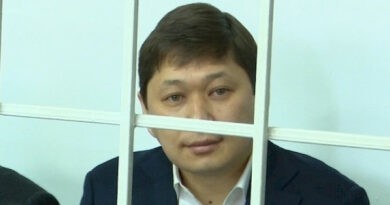
The Board of Appeals of the Nur-Sultan City Court overturned the acquittal of the former head of SK-Pharmacia, Berik Sharip, issued a little more than a month ago.
Recall that SK-Pharmacia performs the function of a single distributor for the purchase of medicines and medical devices for free drug provision within the framework of the state volume of free medical care and in the system of compulsory social health insurance.
As ACCA has already reported, the head of the company, Berik Sharip, was detained in August last year by employees of the Anti-Corruption Agency.
This happened literally the next day after the country’s President Kassym-Jomart Tokayev harshly criticized SK-Pharmacia for problems in the provision of medicines during the pandemic.
After the President’s statement, the Anti-Corruption Agency carried out an analysis of corruption risks in this company and that, based on the results of the check, criminal cases were initiated against the employees of SK-Pharmacia.
“Whoever closely monitors social networks will agree with me that people consider corruption, bureaucracy, and irresponsibility to be one of the main reasons for the complication of the situation with coronavirus. And this is quite true, especially in the context of criminal cases against officials of SK-Pharmacia, the Medical Insurance Fund, as well as several medical institutions of local executive bodies, ”said the head of anti-corruptionists Alik Shpekbaev.
In January of this year, Shpekbayev reported that the investigation into the Berik Sharip case had been completed.
Sharip appeared in court on charges of abuse of office.
The investigation accused Sharip of committing a grave corruption offense against the interests of the civil service and public administration.
As it was established by the investigation, after the outbreak of coronavirus infection, SK-Pharmacia and personally Berik Sharip were assigned the function of ensuring the purchase of the necessary volume of medicines, medical products (including personal protective equipment – PPE), and equipment with timely delivery to the regions of the country. SK-Pharmacia was also instructed to purchase disposable anti-plague suits.
More than $ 19 million was allocated from the budget for the purchase of suits. SK-Pharmacia announced a tender for the state procurement of suits, applications for which were submitted by two companies – Medical Supply Management and Niko Pharm. However, Berik Sharip rejected their proposals and the tender was declared invalid.
Meanwhile, the coronavirus situation worsened every day. The government began to demand from SK-Pharmacia to speed up the solution of the issue with the purchase of anti-plague suits, the shortage of which at that time was more than 1.5 million pieces.
At this moment, the Almaty company Inkar comes into play. They offered “SK-Pharmacy” anti-plague suits made in China. However, the suits they proposed did not fit the requirements, since they did not include glasses, rubber gloves and a respirator with a valve.
However, according to the investigation, Berik Sharip, having abused his powers, changed the requirements for the purchase, technical specification and thereby ensured the victory of Inkar.
“Berik Sharip, having the opportunity to purchase protective suits from other foreign manufacturers, in order to derive benefits and advantages for LLP“ Inkar ”and himself, because of the desire to please the leadership of the Ministry of Health, who demanded the prompt purchase of PPE, set himself with the criminal intent of using the official powers given to him despite interests of the service. Realizing the public danger of his actions, foreseeing the possibility of significant harm and grave consequences in the event of a disruption in the supply of vital personal protective equipment during a state of emergency in the country, Sharip decided to give an unjustified preference to Inkar and conclude a supply agreement “- said in the conclusions of the investigation.
At the same time, Inkar agreed on the supply of suits with the Chinese company Holy Wing, while in China at that time only two large national companies – Sinofarm and Meheco – had permission to sell, transport, and customs clearance of medical products.
It is also worth mentioning one more fact, established by the investigation, an advance payment of about $ 9.5 million was transferred from the budget of the Inkar company. But the company sent this money not to the Chinese supplier, but to the bank to which it had a debt on loans. Naturally, later Inkar returned the money, but the investigation itself assessed this fact as interest-free assistance to the company in a difficult situation.
Meanwhile, Inkar faced difficulties while trying to deliver anti-plague suits to Kazakhstan. Aircraft with urgently needed but completely out-of-specification goods were not released from China. Eventually, it got to the point that a plane from the State Air Medical Service was sent to bring the suits. This flight cost the budget $ 140,000. But the suits were never delivered.
According to the prosecution, all these actions led to an increase in the incidence of coronavirus among doctors and medical personnel.
In addition, during a search in the apartment of the former head of SK-Pharmacia, a barrelless firearm model “Guard” and cartridges for it were found. Sharip kept weapons illegally.
However, judge Kanat Duysembiev, having studied the materials of the case, did not find evidence of Sharip’s guilt in terms of abuse of office. As a result, by the verdict of the court, the defendant was found guilty only of illegal possession of weapons. For this, he was sentenced to a fine of $ 6.6 thousand. But since Sharip was acquitted on the main charge, by the court’s decision, the term spent in custody at the rate of $ 26 for each day of detention went to offset the payment of the fine.
However, the prosecutor’s office filed a protest against this decision and the Appeals Board overturned the decision of the first instance. Berik Sharip was found guilty under both articles incriminated to him and sentenced to three and a half years in prison in a colony-settlement with life deprivation of the right to hold positions in the civil service and the quasi-public sector.