
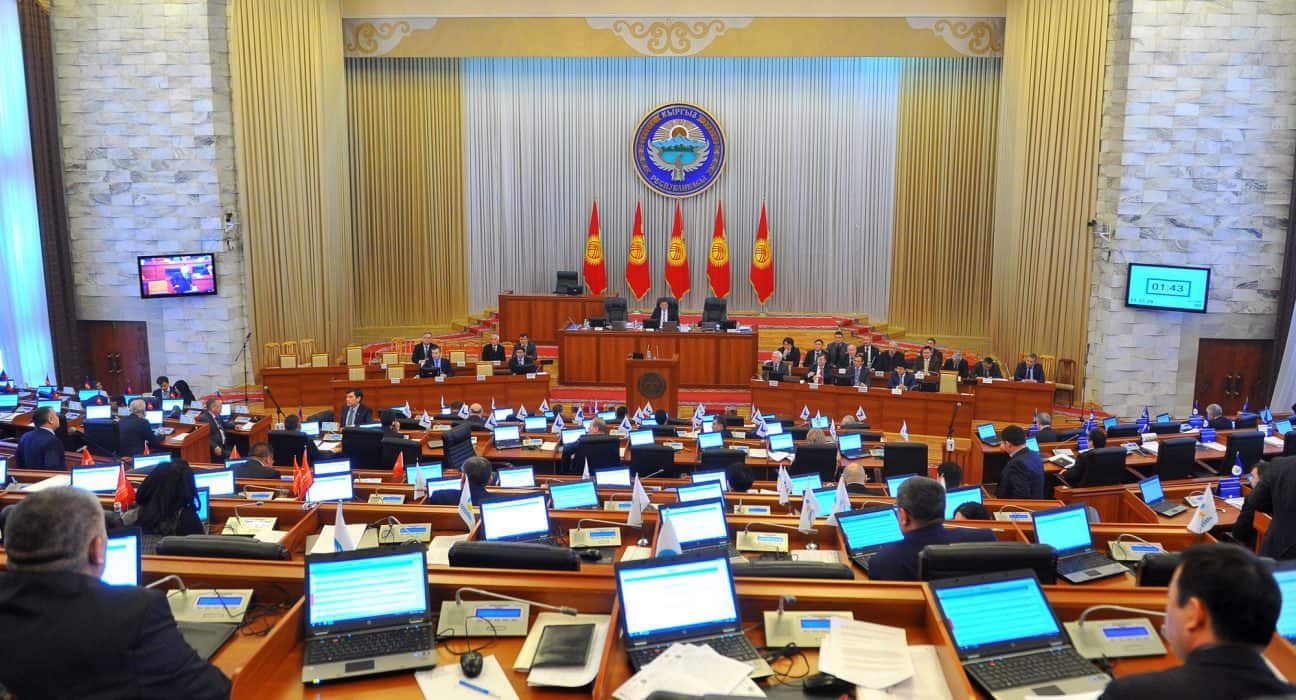
At the meeting on July 22, the deputies of Parliament the Kyrgyz Republic supported in three readings the drafts of the Criminal Procedure Code, the Criminal Code and the Code of Offenses. This legislation, actively criticized by human rights defenders, should come into force on September 1.
The amendments to the Codes were officially initiated by the Prosecutor General’s Office. However, as reported to the media by the prosecutor of the Department for Supervision of Operational-Investigative Activities and Investigation of the Prosecutor General’s Office Sirozhiddin Kamolidinov, the bill was “sent down” by the Presidential Administration.
He explained that the Unified Register of Crimes and Misdemeanors will remain from the current system, but it will be called the Unified Register of Crimes; misdemeanors are excluded. In addition, from the moment of registration of crimes, an electronic file is formed along with a paper one.
Also, the Codes return a pre-investigation check; it will last 10 days with the possibility of extending for another 10 days. After that, decisions will be made to refuse or initiate a criminal case.
“We want to eliminate the fact that a person immediately becomes a suspect. And this is done for the sake of respecting human rights. This is introduced to save time during the investigation, so that the full range of measures is not immediately carried out. The investigation will have a specific deadline for completing the investigation. Now, there is no deadline. It will be two months, and the investigator must make a decision: close the case or send it to court,” said the representative of the Prosecutor General’s Office.
At the same time, activists and experts asked the deputies not to accept these Codes in order to prevent a rollback towards totalitarianism.
In particular, the Coalition against Torture in Kyrgyzstan made a separate appeal. First of all, human rights activists noted that the new Codes were developed without the involvement of a wide range of experts and civil society.
“This practically negates all the progress made by Kyrgyzstan in recent years in the field of human rights and fundamental freedoms. The proposed draft Codes return the negative practice of punitive justice, enshrined earlier in the procedural legislation of the post-Soviet period (1999), which is more repressive towards ordinary citizens, entrepreneurs, business, the media community and the civil sector,” the authors of the appeal say.
It is specified that if the current Criminal and Criminal Procedure Codes (2017) are developed taking into account the principles of the rule of law and provide a high level of protection of human rights and fundamental freedoms in criminal proceedings, enshrined in international human rights instruments, then many norms of the proposed bills run counter to the country’s international obligations under the ratified documents in the field of human rights.
The Coalition against Torture expressed its serious concern that the proposed bills seriously impair the protection of human rights guaranteed by the Constitution of the Kyrgyz Republic, including freedom from torture. A stage of pre-investigation verification was introduced into the draft Criminal Procedure Code, certain rights of the suspect were excluded, the rights of the victim were worsened.
“The stage of pre-investigation verification doesn’t provide mechanisms for an effective investigation of torture and leads to a violation of the principle of equality of parties in criminal proceedings and creates serious risks for a quick and effective investigation of torture and cruel treatment. This procedure for verifying an allegation of the use of torture in the framework of pre-trial proceedings, regulated in part by the Criminal Procedure Code, makes a reference to the Law of the Kyrgyz Republic “On operational investigative activities”, provides only the powers of law enforcement agencies, but doesn’t prescribe the applicant’s rights and, therefore, doesn’t meet the generally accepted requirements for effective and thorough investigations,” human rights activists say.
It is also noted that the new Criminal Procedure Code puts in a vulnerable position the independence of the torture investigation body.
“The body or person conducting the investigation must be independent, both from a formal and practical point of view, and, first of all, the independence of investigators from persons allegedly guilty of torture must be ensured. If an investigation of a complaint of torture is carried out by a person prosecuting an alleged victim of torture, then such an investigation is considered inconsistent with the principle of independence and impartiality,” the Coalition against Torture notes.
Under the new Criminal Procedure Code, a statement or complaint about the use of torture by a person accused of committing a crime will be considered by the same Prosecutor’s Office, which will support state charges in court.
“This mechanism in no way contributes to the effectiveness of the investigation of complaints of torture in principle, and in fact the verification of complaints of torture is carried out in violation of the principle of independence. Thus, the Prosecutor’s Office, which supervises the investigation, and the bodies, which carry out operational-search activities, are obliged to respond to the use of torture during the investigation of a criminal case in which pre-trial proceedings are underway. In addition, when investigating common crimes, prosecutors work closely with police officers. Thus, combining the function of investigating torture and maintaining the state prosecution, as well as close interaction with police officers, has a negative impact on the independence of torture investigations,” the human rights activists say.
“In the presence of such fundamental reasons, it’s impossible to carry out an independent and effective investigation into complaints of torture,” they say.
Attention is also paid to the fact that, under the new Codes, almost all criminal cases related to family and gender violence fall under public-private prosecution cases, which creates serious risks of putting pressure on victims by perpetrators and reducing the number of victims of domestic violence in law enforcement and judicial authorities. The Coalition against Torture emphasizes that these norms contradict the obligations of the state under ratified documents, including the International Covenant on Civil and Political Rights, the Convention against Torture, the Convention on the Elimination of All Forms of Discrimination against Women and the Convention on the Rights of the Child.


Leave feedback about this