
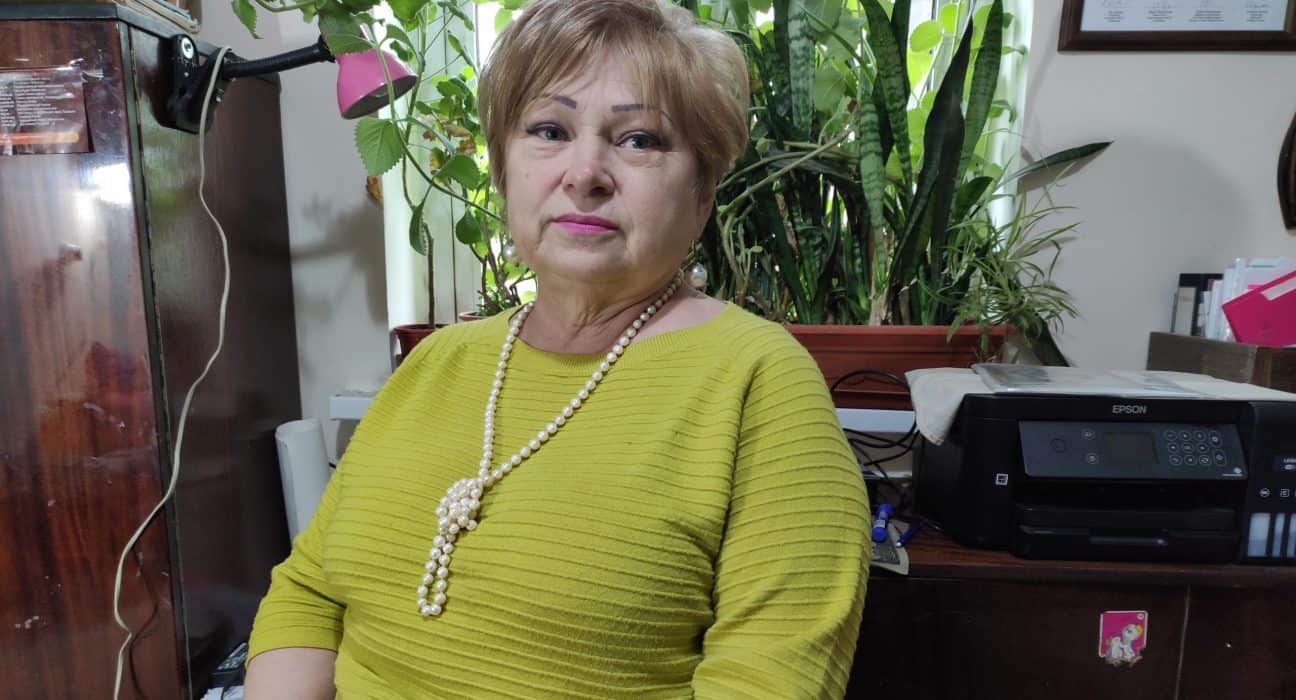
There was a lot of bad things in my life, and as fate has willed it, I became a human rights defender. This was even before my son was accused and I traveled to the prison camps for five years. During these trips, I had to help the uninformed relatives of the prisoners. It was then that I realized how important it is to help others and appreciate the attention to my work.
Since 2007, nine times, I had to defend myself against libel, hooliganism and other “administrative violations” claims. I had to find money to pay fines. In the end, I had to sell my apartment. One of the complaints even demanded that “since Dovlatova is a human rights activist, she should be placed in a psychiatric hospital”.
In 2010, there was even an accusation under Article 277 of the Criminal Code (“Hooliganism associated with a demonstration, threat of use or use of firearms”; a possible punishment is 5 years in prison. I fell under the amnesty in connection with the next anniversary of the independence of Uzbekistan). The reason was the fixation of fraud near the currency exchange office. After being beaten by “currency” speculators, I filed the statement with the police and was recognized as the victim. The investigative authority removed the decision to recognize me as a victim from the case. Such are the realities. Now it looks like a curiosity, but then it was not funny at all…
Since my text is published here, I want to mention the work of the diplomats. For example, the US Embassy in Uzbekistan has been and remains a place where the human rights situation in the country is closely monitored. Ambassadors change their posts; employees leave for other countries. Regardless of who comes to their place, I know exactly that they will listen to me here. It is clear that the Embassy carefully assesses the Uzbek activists according to one criterion – sincerity and an unfeigned desire to defend human rights. It is precisely for these qualities that we, human rights defenders, value all those with whom we are in constant contact. That is worth a lot! For many years, Embassies staff have been following the course of trials with my participation, making it clear with their presence that I am not alone and my cause is right!
It would be right to say that such a long-term moral support of the Embassy made it possible to draw attention to us from other international human rights organizations.
New volunteers don’t allow us to lose heart and submit to the influence of provocations. As before, Uzbek human rights protection is mainly represented by women. However, from a small women’s initiative group, we have transformed into the “Open line” group. I am grateful to Karimbekova Gulbahor, Umarova Bibigul, Viktor Kucherov, Dilarom Dzhuraeva, Dilbar Tashmukhammedova, Sabijon Turkmenov, Klara Sakharova and Svetlana Deryutina. Even during the quarantine, as best we could, we monitored human rights violations in the country, including among prisoners.
Human rights activist Murat Ubbiniyazov from Nukus, Nikolay Kungurov from Yangiyul will always extend a helping hand. And, of course, special thanks to Uzbek and foreign journalists. They help to defend ourselves against slander and attacks. Earlier, independent human rights defenders had a reputation of marginal and crazy persons. And now, local online media don’t think it scorn to communicate with us, they see our real work. Our group began to grow with activists from the regions, two people from Khorezm and Karakalpakstan were able to go out to Tashkent for working meetings.
The attitude of those in power is also changing. And we could not even dream a few years ago that the Main Directorate for the Execution of Punishments under the Ministry of Internal Affairs would show readiness to listen to our demands and respond. ACCA’s critical publications help with this. Alas, no contacts were established with official human rights organizations, which is sad.
… All troubles pass, a ray of hope in the eyes of powerless and deceived people makes us happy. In recent years, hundreds of face-to-face and telephone consultations have been provided to relatives of prisoners, the disabled people. There were hundreds of letters and inquiries to different institutions. Two my rooms often turn into an office and a shelter for people from the regions – Kashkadarya, Fergana Valley, Navoi, Khorezm, Karakalpakstan.
It’s worth remembering the shining eyes of 5 mothers from the colony-settlement No. 42, where, thanks to our posts on the social network and journalistic publications, they have done away with unsanitary conditions! Over the past two years, in the penal colony No. 42, the authorities were forced to demolish the ruinous utility rooms and build new modern buildings for women (laundry, bathhouse, toilet), and a playground for children. They also made repairs in the men’s barracks, opened a workshop for women for the clay figurines’ modelling, and installed new windows.
In 2019, after 6 months of pressure (our complaints to the Ministry of Internal Affairs), the chief was fired in the special detention center at Panelny. Everything was completely demolished and a new barrack with a kitchen was built. Now there is a walking area and a library.
After our publications about the penal colony-6 in Papsky district of Namangan region and the penal colony-7 in Bostanlyk district of Tashkent region, the Ministry of Internal Affairs reacted to the cruel treatment of convicts, getting rid of sadists in uniform. Thanks to our volunteers, it became known about the mass beating in the isolation ward-1 (Tashturma). The electricity was turned off here, and when the video cameras were not working, the guards beat up very young guys. We also inform journalists about this and post it on the social network.
So it turns out that we are dealing with the rights of various categories of citizens. For example, in Shakhrisab district of Kashkadarya region, young girls have disappeared, and the law enforcement agencies are passive in their search. I had to announce this at the session of the Human Dimension Meeting of the Organization for Security and Cooperation in Europe (OSCE) in 2019 in Warsaw.
For three years, my colleagues and I have been registering homeless people. At least, they can visit the clinic now. I provide assistance to freed disabled women and mothers with children to get social housing from the hokimiyats. I write applications, go to receptions with them. A lot of energy is spent on all this, but we feel happy when we manage to help people. I take the statements in defense of sick people (not with disabilities) to the Ministry of Health and put them on Facebook. As a result, people are given a disability group, and minors are given the status of “person with childhood disability”.
We constantly monitor judicial proceedings. Due to the lack of time for writing texts, we began to make live reports on the social network.
In 2018, I filed a lawsuit against the faked elections of the aksakal (elder) of Rakatboshi makhalla in Tashkent, and I won the trial, but the aksakal is still in place. And it is not surprising that now he puts seals and stamps on the complaints of the neighbors in my address. Well, this is a spirit of the times, when lawlessness and nepotism commit outrages.
Maybe this is not the most significant of what we have achieved, but the most memorable.
Now it has become easier, although there are no fewer attempts to humiliate and punish me. The Special Prosecutor’s Office in charge of penitentiary institutions even announced the initiation of a criminal case against me, as the leader of the Open line initiative group. Colleagues from the International Partnership for Human Rights (IPHR), the Norwegian Helsinki Committee (NHC) and the Association for Human Rights in Central Asia (AHRCA) even had to issue the statement in my support, for which I am very grateful.
Sometimes they threaten me in colonies, threaten at the Ombudsman office, and unsuccessfully try to discredit in the eyes of citizens online and offline. This attitude towards human rights protection, alas, has become usual for our Uzbek colleagues.
My team-mates and I got into good training under the previous regime and we are not afraid to resolutely express our position at dozens of pickets near various government agencies. On our calendar, constantly, the date is December 10 – the Human Rights Day.
Tatiana Dovlatova
Leader of the initiative group “Open line”


Leave feedback about this