
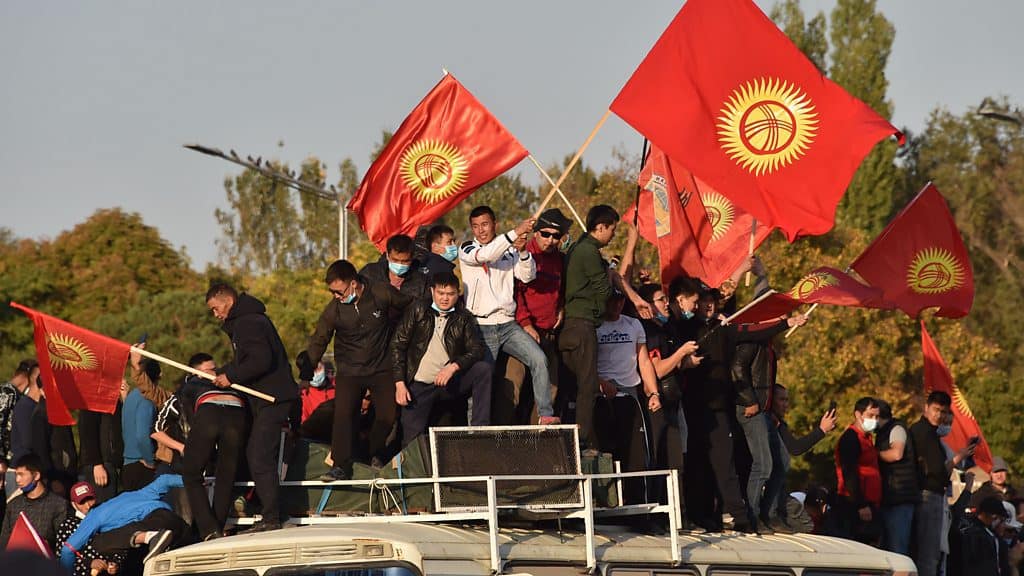
During the revolutionary events, protesters released some politicians who had previously been convicted under various grave articles of the Kyrgyz Criminal Code. One of the former convicts, despite having a criminal record, aspires to be the Prime Minister.
On the night of October 5-6, ex-deputy Sadyr Zhaparov was taken out of penal colony No. 47 in the village of Moldovanovka. In 2017, the District court sentenced him to 11 years and 6 months in a strict regime colony for taking a hostage.
In the evening of October 6, it became known that at an emergency meeting, the deputies of the Kyrgyz Parliament voted for the appointment of Sadyr Zhaparov as Prime Minister. This happened despite the fact that, according to Article 8 of the Constitutional Law of the Kyrgyz Republic, a person with a criminal record, that has not been removed or canceled in the manner prescribed by law, cannot apply for the post of the government’s head.
On the same day, the media disseminated information that Zhaparov was acquitted in the Supreme court. However, later it became known that the Supreme court really considered and granted the motion of the lawyer Sharabedin Toktosunov to review the criminal case against Sadyr Zhaparov on the basis of newly discovered circumstances.
No acquittal was passed to Sadyr Zhaparov. The Supreme court ruled to remit the case, overturning previous decisions.
“What kind of legality can there be in the conditions of the legal vacuum that became in the republic on October 5? This is not even a question. For many politicians, who came under this revolution, the verdict has already entered into force,” says the lawyer Arsen Ambaryan. “The legal mechanisms, that would somehow justify their release, are prescribed in the Criminal Procedure Code. In any case, these should be open trials with the participation of the parties: the prosecutor and the defense. The meeting should consider new or newly discovered grounds, the list of which is limited. Only the operative part of the decision was released on the Internet, from which nothing is clear at all. However, for Kyrgyzstan, this is, unfortunately, a hands-on experience, when at the next coup, supporters of certain politicians release them from custody. Everything that happened demonstrates a real authority of the judiciary.”
Arsen Ambaryan recalled that a similar situation was in the Kyrgyz Republic in 2005, when, after the “Tulip Revolution”, Felix Kulov, an opposition politician to the clan of Akaev, was released from prison. He was convicted in 1999 on charges of excess of powers and embezzlement of funds.
It should be noted that today in the Kyrgyz society only the issue of acquittal of Zhaparov by the court is being discussed, since the politician aspires to be the Prime Minister. However, in addition to him, the supporters of ex-President Almazbek Atambaev were also released.
Atambaev was also released from prison. Last Monday, the third revolution began in Kyrgyzstan. It started with protests against the results of the parliamentary elections held in the country on October 4. The losing parties, as well as individual political associations, that did not get into the Parliament, brought their supporters to the main square of Bishkek, demanding that the results of the plebiscite be canceled.
The rally escalated into clashes with the police. Already at night, the protesters stormed the White House, where the President and his administration usually work, as well as the country’s Parliament. On Tuesday, demonstrators entered the buildings of the State Committee for National Security and state television.
In the course of these events, protesters released some politicians previously convicted under various grave articles of the Kyrgyz Criminal Code from custody.
For example, ex-president Almazbek Atambaev was released from the detention center of the State Committee for National Security. In June of this year, he was sentenced to 11 years and two months in prison. The decision was made by the Pervomaisky District court of Bishkek, finding Atambaev guilty of corruption in the case of the illegal release of the crime leader Aziz Batukaev.
In addition, Atambaev was charged in connection with the clashes in the village of Koi-Tash, in particular, for the attempted violent seizure of power, the murder of law enforcement officers, the organization of mass riots and the taking of hostages.
Together with him, a number of his supporters were released from custody.
The former Prime Minister Sapar Isakov was released too. He was sentenced to 15 years in prison on corruption charges during the modernization of the thermal power plant of Bishkek. The politician was also sentenced to 18 years in prison in a corruption case during the reconstruction of the State Historical Museum and the Hippodrome in Cholpon-Ata. In September, he was transferred to a correctional colony in Moldovanovka.
Ex-Prime Minister Jantoro Satybaldiev was also released from the colony. In 2018, he became a defendant in a corruption case during the modernization of the capital’s thermal power plant. He was sentenced to 7.5 years in prison with confiscation of property.
Ravshan Jeenbekov, an opposition politician, a former member of the Parliament, was also freed. During the events in Koi-Tash, the ex-parliamentarian Ravshan Jeenbekov stated Atambaev’s position. In December 2019, he was detained after interrogation at the Ministry of Internal Affairs. Jeenbekov is charged under articles 244 “Hostage-taking” and 264 “Organization of mass riots” of the Criminal Code of the Kyrgyz Republic. The next day after the arrest, he was placed in the detention center No. 1.
In addition, the former mayor of Bishkek, Albek Ibraimov, who was sentenced to 15 years in prison on a corruption case, the ex-chief of the presidential apparatus Farid Niyazov, accused of taking hostages during the events in Koi-Tash, and the state security officer Kanat Sagymbaev, suspected of organizing riots, murder and abuse of authority.


Leave feedback about this