
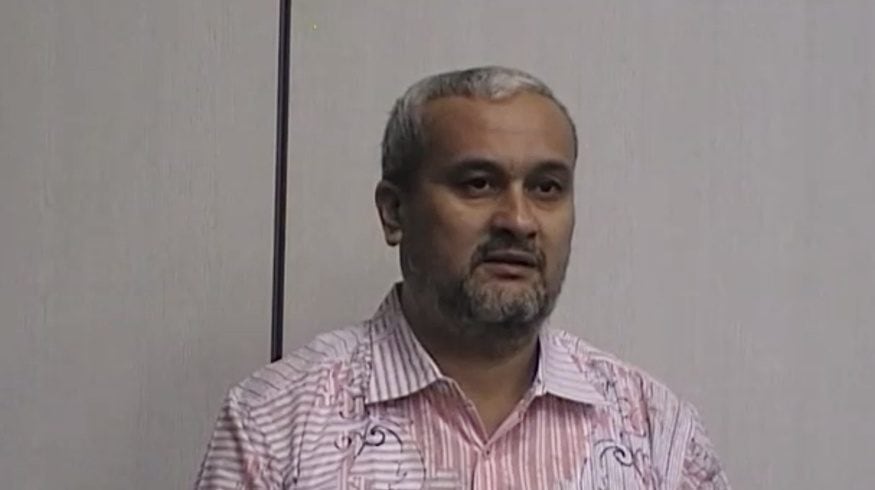
On August 22, journalist Bobomurod Abdullayev was taken to Tashkent on a military plane at noon. After being extradited from Kyrgyzstan to Uzbekistan, the journalist was under the care of employees of the State Security Service for more than ten hours. After arriving, lawyer Sergei Mayorov was able to see his client only five hours later.
In the building of the State Security Service, he was interrogated at intervals, the result of the interrogation was a video recording. On it, with the help of a teleprompter, Bobomurod read out a previously prepared text, expressing gratitude to the leader of the country for his attention to his fate. According to the press service of the State Security Service, “taking into account the appeal of the mother of the detainee to the President of the Republic of Uzbekistan Mirziyoyev, the measure of restraint was changed to sign a statement undertaking a proper behavior”. At 11 pm Abdullaev left the State Security Service.
Before being detained and filming, he was allowed to talk with his relatives living in Khorezm. His mom commented that her son was being treated well. “When I asked my son not to take the blame on himself if he was accused of involvement in the materials signed Kora Mergan, my son shed a tear.”
Release does not exempt from the threat of criminal prosecution. According to the Criminal Code, the measure of restraint is applied to accused, defendants, convicted persons, and persons who have been declared insane or who have become mentally ill after committing a crime. Bobomurod can move freely within Uzbekistan and leave the country only with the permission of the investigator.
The Uzbek authorities do not disclose the details of the accusation, but according to lawyers in Kyrgyzstan, they intend to charge him under Articles 158 (Encroachments on the President of the Republic of Uzbekistan) and 159 (Encroachments on the constitutional order of the Republic of Uzbekistan) of the Criminal Code of Uzbekistan. The possible sentence entails imprisonment for up to 20 years.
As ACCA previously posted, the special arrest operation in Bishkek and subsequent extradition of the journalist was prepared by the special services of the two countries and, according to the ACCA expert, is part of the propaganda campaign of the Uzbek authorities.
“According to some sources, the scenario of detention and extradition was drawn up in advance. To prevent information leaks, employees of the State Committee for National Security of Kyrgyzstan deceived local lawyers, denying in communication with Abdullayev under the pretext of quarantine, ”the expert is sure. “The very appeal of the journalist’s mother appeared on August 11, two days after the arrest of the journalist. The State Security Service could well have prevented the appearance of video on the network, being sure of the seriousness of the alleged crimes. And the president was not worried about the fate of some journalist these days, everything was decided ahead of time.”
The accusations against Abdulaev are related to a series of publications on the network under the pseudonym Qora Mergan (Black Sniper) about the past and present of Mirziyoyev, the presidential clan, and his inner circle. On August 4, the Facebook administration announced that the Black Sniper page was blocked “due to numerous complaints from the state authorities of Uzbekistan.” In a special statement, the complainants are “deeply concerned about the libelous, offensive and ridiculous publications by Black Sniper”. Blogs with similar names were created by unknown people in June and July to smash the growing popularity of Qora Mergan.
After Bobomurod was detained, informing users continued on the telegram channel of the same name. Following the disturbing news about the journalist, the number of the channel’s subscribers began to skyrocket.
The ACCA expert suggested that an ordinary denunciation of one of the Uzbek political emigrants cooperating with the State Security Service of Uzbekistan could have become a formal basis for the persecution of Abdullayev.
“In this situation, the authorities have solved two problems: once again they intimidated the country’s media community and showed their peacefulness, designed to improve international ratings,” the expert concluded.
Local media limited themselves to retelling the message of the State Security Service press service.


Leave feedback about this