
Kazakh law enforcement agencies have lost an important amendment to the anti-corruption law. Moreover, it was the amendment, which the President of Kazakhstan, Kasym-Zhomart Tokaev, personally instructed to accept.
This curious detail surfaced during the discussion of the draft law “On amending and adding to some legislative acts on anti-corruption issues” in the lower house of the Parliament.
The deputy Vasily Oleinik noted in his speech that among the employees of the Anti-Corruption Service there are so-called “werewolves in uniform”, who are involved in provocative and other illegal actions.
“At the same time, the Criminal Code doesn’t establish liability for provocative acts. Meanwhile, the President of Kazakhstan, Kasym-Zhomart Tokaev, instructed to establish such responsibility. Deputies introduced an amendment to the bill, which provides for criminal liability for provocation of crimes by employees of a law enforcement or special state body. And the General Prosecutor’s office supported this proposal of deputies,” said Oleinik.
The words of the parliamentarian were warmly supported by the speaker of the lower house, Nurlan Nigmatulin.
“It’s very important that now the bill provides for criminal liability not only of the anti-corruption body, but also of all law enforcement agencies for provoking any kind of crime. As it was reported to me, this norm was lost in the bill by law enforcement agencies on the way to the Parliament. Although, as deputy Oleinik noted, this was a direct order from the head of state. What happened? Why was it lost on the way? It’s difficult for me to imagine it! The head of state publicly instructed your agency, as the developer of the bill, to develop such a norm and introduce it. But the bill came here, and there isn’t this norm,” Nigmatulin asked a representative of the Anti-Corruption Agency.
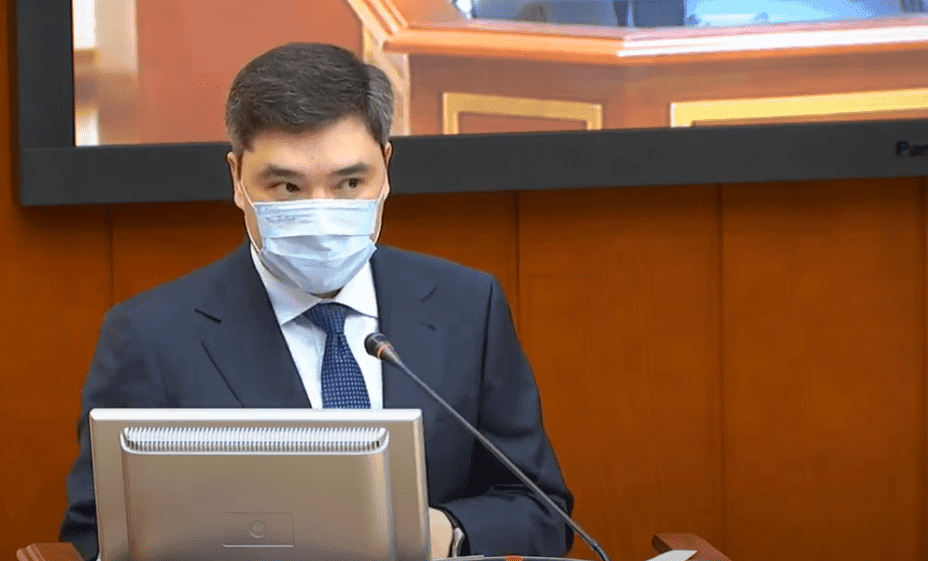
In response to this, the deputy chairman of the Anti-Corruption Agency, Olzhas Bektenov, tried to justify himself:
“Yes, indeed, the President gave such an order. But the main developer of this part was the Prosecutor General. The Prosecutor General’s office provided for a number of measures to strengthen responsibility, including for provoking crimes, for illegal detentions, and so on. This law was adopted at the end of last year. And our bill went in parallel with the Prosecutor’s office,” Bektenov explained.
However, Nigmatulin interrupted his excuses, noting that he didn’t know such laws.
“It was necessary to introduce these norms into the Criminal Code. Only now the deputies are introducing it. That’s what it was about! When the head of state gives an order, especially when he gives them publicly, please don’t lose such orders! Therefore, everyone be responsible for that. The Anti-Corruption Service supports this rule. Does the Prosecutor General support it?” he began to rouse representatives of departments one by one.
The Prosecutor General’s office answered in the affirmative, the Ministry of the Interior too.
“We believe that the exclusive right to criminal prosecution should be accompanied by increased responsibility,” Vice-Minister of the Internal Affairs, Aleksey Kalaichidi, remarked with emotion.
“And how did you then lose it (this norm)? The discussion put a negative resolution!” Nigmatulin grinned.
“The remark is accepted,” sighed Kalaichidi.
“This is not a remark. This is a serious rebuke. How do you carry out the instructions of the country’s head!” Nigmatulin said, adding that the lost norm would nevertheless be adopted by law.
In turn, the deputy Pavel Kazantsev said that it is necessary to legislatively prescribe the timing of the delivery of gifts by state employees to the treasury.
“Now there is a norm in the law that the official, who received the gift, must deliver it within seven days. If he doesn’t it, then he will be held accountable. However, at the same time, the law doesn’t clearly explain at what point the counting of these seven days begins. Since delivery? Since discovery? I believe that in order to avoid discrepancies, the law must spell out a clear, definite norm that liability arises if the gift is not handed within seven days from the moment it was discovered by an official. Otherwise, he may declare that he didn’t know from what moment the counting of seven days starts, and he doesn’t care a button about all the charges,” Kazantsev said.
Nurlan Nigmatulin tried to turn it into a joke.
“Today, under quarantine, the phrase “don’t care” can be equated to a terrorist threat. And if it concerns the employees of the anti-corruption service, then this is really fatal! Worse than the coronavirus!” the speaker joked. Deputies laughed in response.
In turn, Olzhas Bektenov didn’t agree with the deputy Kazantsev, saying that all the terms in the current law are prescribed.
“As for the money received on the account of a civil servant or members of his family, it says that from the moment of discovery. Within two weeks, he/she is obliged to transfer money to the budget. As for gifts – from the moment of receipt. The logic was such that the receipt and discovery of a gift occurs in one day. Well, hypothetically, you can imagine that someone brought and set it, and the official didn’t know, and then discovered. And if law enforcement issues arise, let us think before the second reading how to formulate this norm better in order to avoid divergence,” Bektenov noted.
Bektenov also said that one of the amendments is to expand the list of organizations where it will be possible to report facts of corruption.
“If a public servant has doubts that his/her head will properly respond to his/her report of a possible corruption offense, he/she can contact the Anti-Corruption Service directly, as well as other law enforcement agencies. With our bill, the list of agencies, where you can report, is expanding,” Bektenov explained.
After discussion of the bill, deputies of the lower house of the Parliament approved the proposed amendments to the laws on anti-corruption issues in the first reading.


Leave feedback about this