
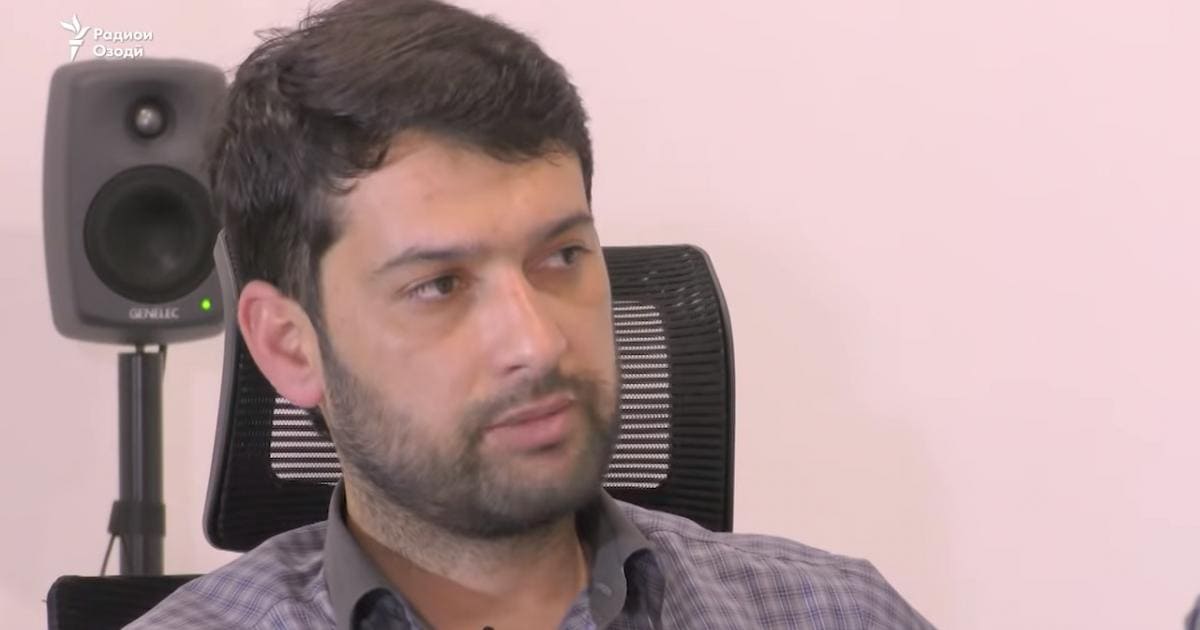
On April 16, the District court of Shokhmansur district (Dushanbe city) sentenced the independent journalist Daler Sharipov to one year in prison on the basis of part 1 of article 189 of the Criminal Code for “fomenting of religious strife”. Civil society organizations, that have jointly prepared this statement, express concern that the 32-year-old journalist, who often covered human rights and religious freedoms in his articles, and criticized government policies in this area, has been the victim of persecution based on his professional activities. They call on the authorities of Tajikistan to release him as soon as possible.
Daler Sharipov was detained on January 28, 2020 by officers of the State Committee for National Security (SCNS) on charges of “inciting ethnic, racial, local or religious strife”. The broad wording of article 189 of the Criminal Code of the Republic of Tajikistan contradicts article 20 (2) of the International Covenant on Civil and Political Rights and is a clear example of normative acts that can be used as an illegal punishment for expressing an opinion that does not imply incitement and does not entail the risk of incitement of hostility, violence or discrimination.
In its concluding observations published in August 2019, the UN Human Rights Committee urged the authorities of Tajikistan to “effectively protect independent journalists and media workers from all forms of intimidation and to refrain from using civil and criminal prosecution provisions, including the fight against extremism, as well as other regulatory legal acts, as an instrument to stop critical coverage of issues of public interest”.
However, the development of events concerning the case of Daler Sharipov indicates that the authorities do not intend to implement this recommendation. On January 30, 2020, a crossing measure in the form of detention was selected for Daler Sharipov, after which he was placed in the pre-trial detention center of the SCNS in Dushanbe.
In early February, the Prosecutor General’s office issued a statement alleging that over the past seven years, Sharipov has published more than 200 articles and comments of an “extremist nature aimed at fomenting of religious strife” on social networks, as well as illegally publishing 100 copies of the dissertation, which allegedly “was developed in the context of the Muslim Brotherhood movement, whose activities are recognized as extremist in Tajikistan and prohibited.
However, the indictment referred only to Daler Sharipov’s dissertation on “Mohammed and terrorism,” and not a word about two hundred articles and comments of an “extremist nature” that the journalist allegedly distributed.
During the hearing, the state prosecutor demanded that the court sentence Sharipov to two years and four months in prison. Article 189 (part 1) provides for a maximum sentence of five years in prison. According to Daler Sharipov’s father, the journalist assumed that his dissertation “Mohammed and terrorism” would be used as a deterrent for young people who might be involved in terrorist and extremist groups. According to the lawyer, in his final statement to the court, Daler Sharipov denied the incitement to hatred, but admitted that he made mistakes in his treatise.
According to Abdurahmon Sharipov, the lawyer of Daler Sharipov (not his relative), the trial, which was scheduled for April 13 in the metropolitan court of Shokhmansur district, was adjourned on April 15 due to the absence of a prosecution representative. During the trial, which began on April 15, only the lawyer, witnesses and Sharipov’s parents were allowed into the courtroom, while dozens of journalists and civil society activists were denied admission. According to Abdurahmon Sharipov, the court justified its actions, referring to the recommendations of the World Health Organization to prevent the spread of the coronavirus epidemic. The only civil society observer, who was admitted to the courtroom during the resumption of the April 16 trial, was Nuriddin Karshiboev, head of the National Association of Independent Media in Tajikistan. A temporary access was also given to another civil society activist Oinychol Bobonazarova, while many others were denied.
There are no international guidelines regarding the prevention of public access to court hearings as a precaution against the spread of coronavirus. In many countries, where the virus was detected, it was decided to temporarily postpone all non-urgent court hearings or hold hearings in large halls, which allows for social distance. Some of them are looking for ways to ensure the functioning of courts through remote access tools such as video conferencing.
At the same time, the authorities of Tajikistan continue to insist that the coronavirus, which today has killed more than two million people in more than 200 countries of the world, has not yet entered the territory of the country. So, there are no restrictions on holding meetings.
The statement was prepared by the International Partnership for Human Rights together with member organizations of the Coalition against Torture and Impunity in Tajikistan, as well as local civil society institutions and activists:
Public organization “Pamir Lawyers Association”;
Public organization “Bureau for Human Rights and Rule of Law”;
Association “People’s Assessors of the Republic of Tajikistan”;
Public organization “Natchoti cudacon”;
Public organization “National Association of Independent Mass Media of Tajikistan”;
Public Foundation “Notabene”;
Public organization “League of women with disabilities Ishtirok”;
Public organization “World of Law”;
Public organization “Otifa”;
Public organization “Office of civil liberties”;
Public Foundation “Legal initiative”;
Public organization “Homa”;
Public organization “Center for Human Rights”;
Public organization “Law and Prosperity”;
Oinychol Bobonazarova, PO “Perspective +”;
Shukhrat Saidov, lawyer;
Zoir Razzokov, medical expert.


Leave feedback about this