
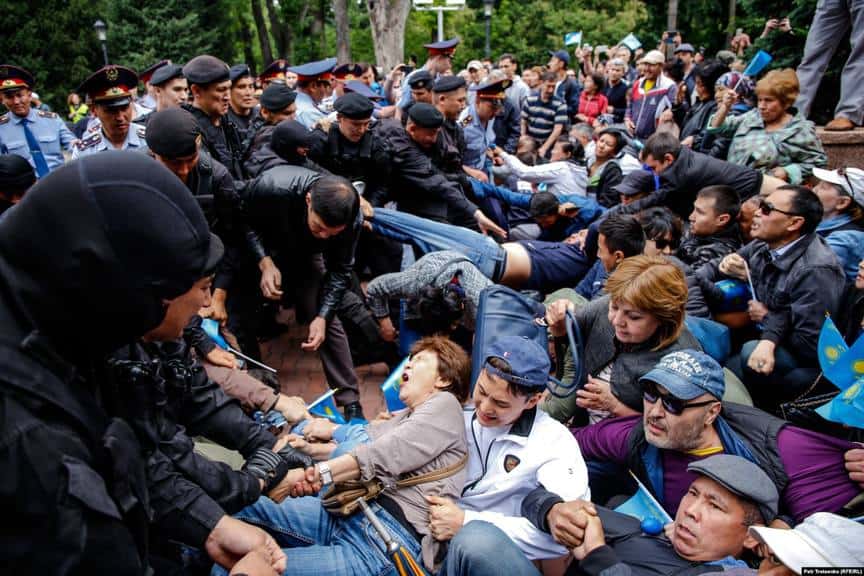
During and after the January events, more than 10,000 people were detained in various regions of the country. Such figures are contained in an analytical report on the observance of the rights of persons detained during and after the January events of 2022, at the stage of pre-trial investigation, prepared by the Kazakhstan International Bureau for Human Rights together with the Human Rights Alliance for Fundamental Rights.
According to the authors of the report, the vast majority of detainees on those days were released after a few days or weeks, which makes it somewhat difficult to fully assess the observance of their rights, since in many cases the procedural standards of detention were not observed, and violations were not recorded.
However, human rights activists managed to obtain reliable information about violations from hundreds of other detainees and those placed in custody – about gross violations of many fundamental rights and freedoms, including liberty and security of person, freedom from torture, and a fair trial. It was based on their testimony that an analytical report was drawn up, which was also based on the results of a survey of most detainees, their relatives, and lawyers.
“The survey was conducted in June-July 2022. The questionnaire survey covered 63 detainees, 62 men, and 1 woman,” the report says. The number of respondents under the age of 18 was 5%, 18-25 years old – 25%, 25-35 years old – 35%; 35-50 years old – 29%; 50-60 years old – 5%; and over 60 years old – 1%. Most of the respondents live in Almaty – 62%. At the same time, 81% of the total number of respondents had not been prosecuted before.
With regard to 52% of the respondents, pre-trial prosecution was or is being carried out under the article “Mass riots”, under the article “Theft or extortion of weapons, ammunition, explosives, and explosive devices” – 13%; under the article “Theft” – 12%, under the article “Use of violence against a representative of the authorities” – 11%, under the article “Illegal acquisition, transfer, sale, storage, transportation or carrying of weapons, ammunition, explosives, and explosive devices” – 6 %; under the article “Attack on buildings, structures, means of communication or its capture” – 2%; and 1% each under the articles “Armed rebellion”, “Robbery”, “Hooliganism” and “Dissemination of deliberately false information”.
“However, according to the study, the grounds for detention were reported only in 21% of cases, and in 71% of cases, this was not done in violation of the law. However, in 8% of cases, it remained unknown. The rights of the detainee were not explained in 73% of cases,” the report says.
At the same time, the authors emphasize that in 63% of cases the police did not explain to the detainees their rights.
“In 76% of cases, the detainee could not contact a lawyer of his choice, and in 71% he could not use the right to “call”. Moreover, in relation to those who were detained in the first days of the January events, neither lawyers nor relatives could get access to the detainees for several days with reference to the state of emergency,” the authors cite sad statistics.
It should also be noted that only 22% of detainees were registered in the ledger.
A sad picture emerges in terms of torture and the use of unlawful interrogation methods. So 55% of the detainees reported that they had been beaten.
“The conditions of detention, both at the initial stage and after being taken to pre-trial detention centers, are assessed by the detainees, their lawyers, and relatives as inhumane in more than 65% of cases, and this remained unexplained in 8% of cases. In 71% of cases, as a result of the survey, it was found that torture was used against the detainees. In 83% of cases, lawyers filed complaints of torture. In 83% of cases, these complaints were checked and in 77% of cases it was possible to identify suspects, but some results in the form of establishing the status of the victim of torture and detaining suspects were obtained only in 18% of cases,” the authors of the study note.
The report notes that although the questionnaire and the survey meet the requirements of validity and relevance, the sample based on a survey of 63 lawyers (and in some cases detainees or their relatives) cannot be called sufficiently representative, since in general during and after the January events more than 10,000 people were detained, several hundred were detained for several days, and many of them were placed under preventive detention.
Nevertheless, the survey covered approximately 10-20% of those who were placed in custody in seven regions of the country, which allows us to assess and identify some systemic problems with respect for the rights to liberty and security of person, to a fair trial (at the stage of pre-trial investigation ), legal aid and freedom from torture and ill-treatment.
“It follows from this that the existing legislative, institutional and practical guarantees for ensuring the right to freedom from torture and other cruel, inhuman or degrading treatment or punishment are not effective enough and are observed only to a small extent,” the authors of the study summarized.


